

FAIMS Technology
Owlstone Medical’s patented FAIMS technology can be applied to rapidly monitor a broad range of volatile compounds from breath, urine and other bodily fluids with high sensitivity and selectivity
FAIMS FOR MEDICAL APPLICATIONS
FAIMS for Medical Applications
Owlstone Medical’s FAIMS technology provides a sensitive, selective and fast means of analyzing volatile organic compounds (VOCs) collected from biomarkers in breath, urine and other clinical samples. FAIMS instruments (such as the Lonestar VOC Analyzer and ultraFAIMS) are portable, easy to use and affordable, making them ideal for research seeking to develop point of care tests.
This video describes FAIMS theory in more detail and includes an animation of ions travelling through our FAIMS device.
FAIMS is being used in clinical reearch to identify and measure VOCs related to illnesses including cancer, asthma and tuberculosis. FAIMS could contribute to developing new tests that could support non-invasive early diagnosis of these diseases and many others.
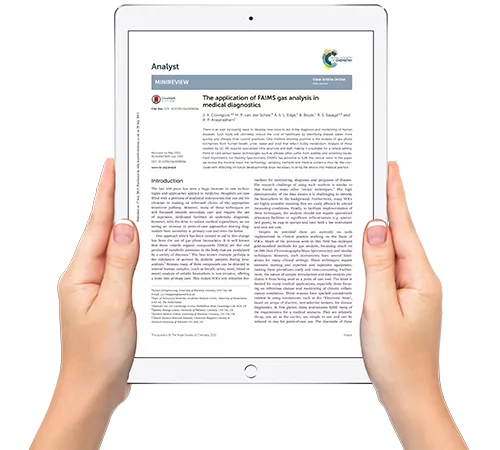
FAIMS THEORY
How Does FAIMS Work?
Field Asymmetric Ion Mobility Spectrometry (FAIMS) is a variant of ion mobility spectrometry – a method of distinguishing charged gaseous molecules according to differences in the speed that they move through a buffer gas under the influence of an oscillating electric field.
After ionization, the VOC ions pass through channels across which an asymmetric RF field is applied. Under the first portion of the waveform, ions will drift in one direction at a velocity based on their individual mobility in that electric field. As the field polarity is reversed the ions change direction and speed based on the new field conditions. As the mobility of the ions during the two parts of the waveform is rarely equal, there is usually a net drift towards one of the electrodes. In FAIMS, this net drift is corrected for by applying an additional DC voltage, known as the compensation field (CF), focussing specific ions through the device to the detector.
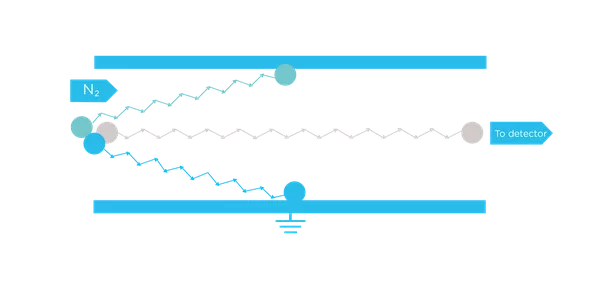
The figure on the left shows three ions, all demonstrating different mobility behaviours under the influence of the electric field. The trajectory of two ions collide with walls, however the trajectory of the third ion has the appropriate DC voltage applied, meaning it traverses the device. The FAIMS device scans these DC voltages, producing a compensation field spectrum for the transmission of all ions.
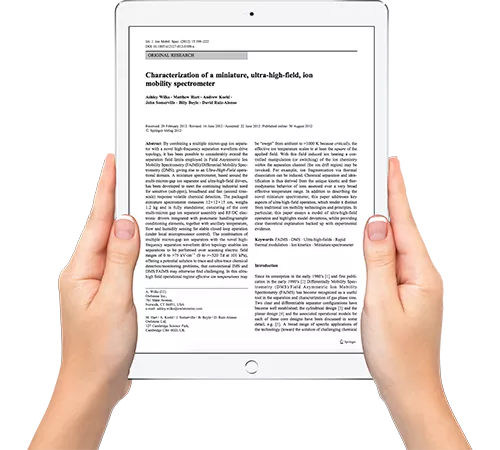
FAIMS & BREATH BIOPSY
How does Owlstone Medical use FAIMS in Partnership with GC-MS?
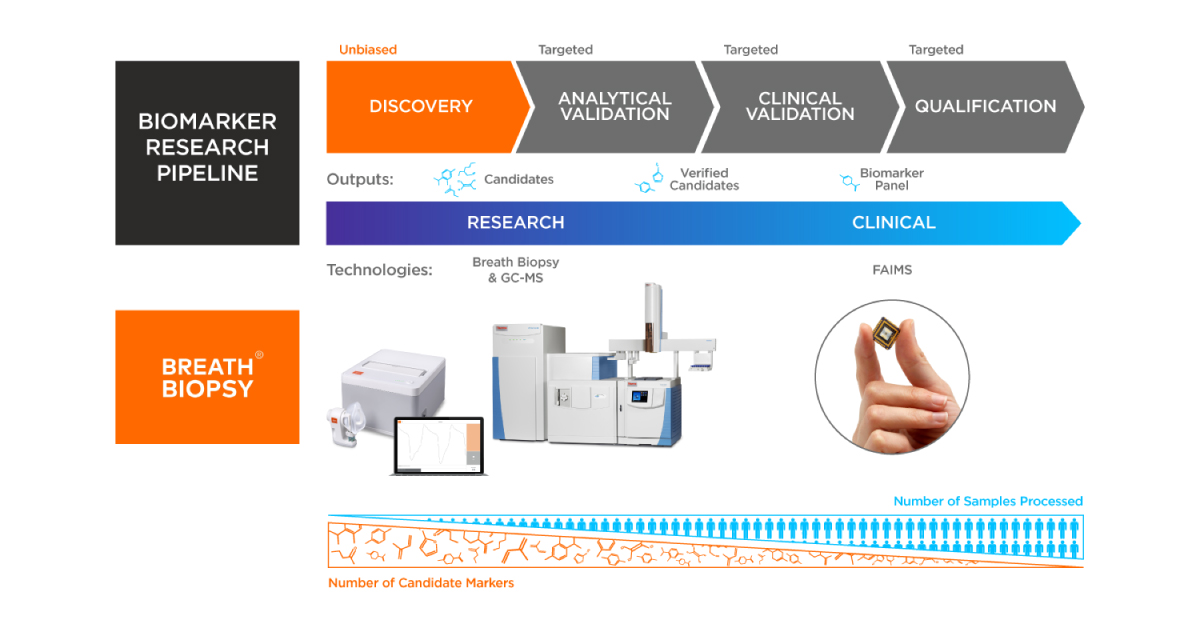
Much research into medical diagnosis using VOC biomarkers currently focuses on high end analytical techniques such as gas chromatography-mass spectrometry (GC-MS), rather than sensor technologies such as FAIMS. Indeed, at Owlstone Medical we also use GC-MS prominently in our work – it’s a vital part of our Breath Biopsy Platform. However, while it’s possible to compare the merits of these different techniques for VOC analysis, they are fundamentally complementary.
The latest high-resolution GC-MS platforms excel in identification and quantification of unknown biomarkers within the complexity of a breath sample – providing vital biological insight across the full range of VOCs on breath, which simply isn’t possible with many other approaches. Unlike FAIMS, however, the utility of these methods can be diminished in clinical settings where there is a greater need for cheap, fast and accessible solutions.
FAIMS has the ability to rapidly monitor a broad range of VOC biomarkers with both high sensitivity and selectivity and can offer an immediate yes/no response. This means that, where VOC biomarkers are known, FAIMS can help translate those biomarkers into a cost-effective clinical test, that delivers clear and rapid diagnostic results at the point of care.
ADVANTAGES OF FAIMS
The Benefits of FAIMS over other Sensing Technologies
FAIMS has many advantages over other sensor-based systems. For instance, compared to FAIMS, ‘Electronic Nose’ (eNose) technologies, which use arrays of non-selective chemical sensors, suffer from stability and sensitivity issues. Unwanted chemical interactions between VOC biomarkers and the sensors can lead to poor intra-device repeatability, limited temporal stability and poor chemical selectivity. These problems severely hamper the translation of eNose technology from the lab bench to the doctor’s office.
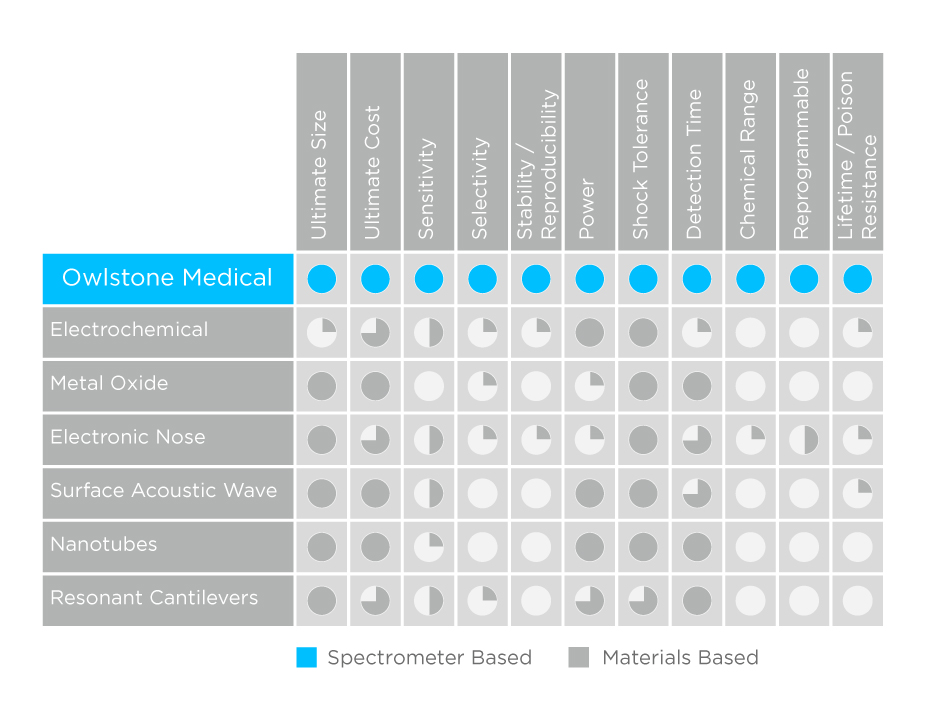
The schematic overview (left) shows the main advantages of our FAIMS technology over the other main types of medical diagnostic sensor.
FAIMS is the most sensitive and selective sensing technology, while also possessing the greatest chemical range. FAIMS is capable of detecting aromatic amines, amines, phosphorus compounds, sulfoxides, ketones, aldehydes, esters, alkenes, alcohols, aromatics, alkanes, and more.
Why Choose FAIMS?
- SENSITIVE
Detection levels below part per billion (ppb)
- SELECTIVE
FAIMS can target specific VOCs in breath, urine and other clinical samples
- VERSATILE
The FAIMS chip can be re-programmed in software to detect different VOCs, depending on the application
- PORTABLE
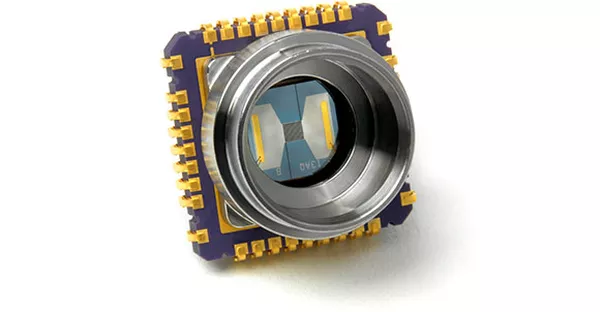
The dime-sized FAIMS chip is incorporated into portable instrumentation suitable for point-of-care use
- NON-INVASIVE
FAIMS can detect disease biomarkers non-invasively from breath, urine and other biofluids
- EASY TO USE
Our instruments are designed to be used by non-specialists
- AFFORDABLE
FAIMS can detect VOCs at a fraction of the price of other techniques, such as GC-MS